
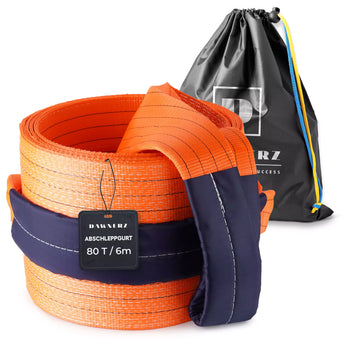


Heavy-Duty Tow Strap - 80,000 kg Minimum Breaking Strength
B2B sales only.
- Minimum Breaking Strength (MBS): 80,000 kg
- Webbing width: 300 mm
- Webbing thickness: 5 mm
- Multi-ply construction
- Reinforced end loops
- Color: Orange
- Material: Polyester (PES)
- Application: Towing & recovery (not for lifting operations)
Contact
Dawnerz GmbH Eichhornstraße 3
c/o Indy by Industrious
10785 Berlin, Germany
Inquiries: info@dawnerz.de
+49 158 886 42008
Product and User Safety Information
Description
The Dawnerz series of tow straps is engineered for safety, reliability, and durability.
Safety and Reliability:
- Robust construction – multi-ply polyester webbing with reinforced end loops.
- Reinforced loops – enable attachment to various shackles.
- Industrial-grade polyester webbing – minimizes elongation under load and provides controlled tension during recovery and towing operations.
Reliable Performance:
- Applications – towing and recovery of vehicles and machinery, e.g. in construction, mining, road transport and agriculture.
- Easy inspection – allows quick visual checks before each use to detect wear or damage.
Comfort and Usability:
- Effortless storage – the flexible polyester webbing folds or rolls easily for space-saving storage.
- Rapid deployment – compact design reduces downtime and supports an efficient workflow.

Technical Data
| Attribute | Webbing width | Loop length | Webbing thickness | Color | Nominal length | Minimum Breaking Strength (MBS) |
|---|---|---|---|---|---|---|
| ABG | 90 mm | 400 mm | 5 mm | Yellow | 6-8 m | 20000 kg |
| ABG | 120 mm | 450 mm | 5 mm | Grey | 6-8-10 m | 28000 kg |
| ABG | 150 mm | 500 mm | 5 mm | Red | 6-8-10 m | 35000 kg |
| ABG | 180 mm | 550 mm | 5 mm | Brown | 6-8-10 m | 45000 kg |
| ABG | 240 mm | 650 mm | 5 mm | Blue | 6-8-10 m | 60000 kg |
| ABG | 300 mm | 750 mm | 5 mm | Orange | 6-8-10 m | 80000 kg |
| ABG | 300 mm | 750 mm | 10 mm | Orange | 8-10 m | 150000 kg |
Selection Guide
Selecting the correct tow strap is critical for the safe and effective recovery of heavy vehicles. Here is a guide to help you choose the perfect strap for your needs:
Minimum Breaking Strength (MBS) – Focus on MBS: Choose a tow strap with a minimum breaking strength (MBS) that exceeds the expected towing load.
Towing vs. Recovery: For recovery operations, especially when winching or pulling uphill, a higher MBS is recommended than for simple towing on flat surfaces. Keep in mind that factors such as terrain, mud depth, and deflated tires can increase the required pull force. Always assess the situation before using a tow strap.
Length – 6 meters: A 6-meter strap is suitable where room to maneuver is limited.
Length – 8 & 10 meters for off-road advantages: For off-road recovery, an 8–10 meter strap offers additional reach.
Secure Attachment: We recommend using tow straps with loops for secure attachment with steel or soft shackles. Loops provide more flexibility and versatility when connecting to various recovery points on heavy vehicles.
Safety Reminder: Safety is always the top priority. Inspect your tow strap for damage before each use and follow the operating instructions of both vehicles involved to ensure proper towing procedures.
Safety Information
Safety is always the top priority when using tow straps, especially with heavy vehicles. Here are some essential safety points to follow:
- Use only the designated tow points on both vehicles. Never attach the strap to bumpers, axles, or suspension components.
- Ensure the recovery path between vehicles is clear of obstacles.
- No one should stand between vehicles or near the tow strap while it is under tension.
- Maintain clear communication with the driver of the towing vehicle.
- Apply slow, steady pulls to avoid sudden jerks or spikes of load on the strap.
- If the vehicle does not come free easily, stop and reassess the situation. Do not try to force it.
By following these guidelines, you can select the correct tow strap for your heavy vehicle recovery needs while prioritizing safety throughout the process.


Attachment Methods
When using towing straps, employing the right attachment methods is crucial for ensuring safety and efficiency. Always refer to the towing strap's user manual.

Shackles are critical for creating secure attachment points between the towing strap and the vehicle.

Using a straight line pull for vehicle recovery is essential for maximizing the efficiency of towing operations. This method ensures that the towing force is applied in a direct line, reducing the risk of the strap twisting. By maintaining a straight pull, you can achieve maximum force transfer, allowing for a more efficient and controlled recovery.

Reinforced Eyes
The tow straps feature reinforced end loops for connection with steel or soft shackles.
Industrial Grade Webbing
Dawnerz tow straps are manufactured using high-quality industrial-grade polyester webbing. Models with 20,000 to 80,000 kg minimum breaking strength are two-ply; the 150,000 kg model is four-ply.
Product FAQs
What material are Dawnerz towing straps made from?
Our towing straps are manufactured using high-tenacity polyester, known for its durability and low stretch.
Are Dawnerz towing straps suitable for off-road vehicle recovery?
Yes, Dawnerz towing straps are suitable for off-road recovery. The polyester material has low stretch.
What is the Minimum Breaking Strength (MBS) of Dawnerz towing straps?
Our towing straps come in different capacities, with MBS ranging from 20,000 kg to 150,000 kg. Be sure to choose a strap appropriate for your specific towing or recovery needs.
How should I store my towing straps to ensure longevity?
To prolong the life of your towing straps, store them in a cool, dry place away from direct sunlight and chemicals. Avoid exposing them to sharp edges or abrasive surfaces when not in use.
How do I properly use a towing strap for recovery?
Ensure that the towing strap is securely attached to the towing and recovery points of both vehicles. Gradually apply tension to avoid sudden jerks, which could damage the strap or vehicles. Always follow safety guidelines and ensure both drivers are aware of the process.